Is delta-8 THC legal?
Delta-8's legal status is the most complicated part of this story, and it's actively changing. The short version: delta-8 operated in a federal gray zone from 2019 through 2025, and a 2025 law is set to close that gray zone at the federal level in late 2026.
The federal picture
The 2018 Farm Bill's definition of hemp only referenced delta-9 THC, which is how delta-8 products became federally available in the first place. In November 2025, Congress passed and President Trump signed P.L. 119-37, which amends the hemp definition to use a "total THC" standard (including THCA and other THC variants), caps finished hemp-derived cannabinoid products at 0.4 milligrams of total THC per container, and explicitly excludes synthesized or manufactured cannabinoids. The effective date is November 12, 2026. When that takes effect, most delta-8 products currently on the market will no longer fit the federal hemp definition.
There are pending bills that would delay, modify, or repeal P.L. 119-37, so the specifics could shift between now and the effective date. The broader direction — federal regulators narrowing the loophole — is the stable story.
The state patchwork
Even before the federal changes, state treatment of delta-8 has varied widely. Some states banned delta-8 outright. Some regulated it under their hemp rules. Some regulated it under their cannabis programs. Others left it in a gray zone of their own. State laws also frequently change, and state-level restrictions often preempt or contradict what's federally allowed.
Bottom line: If you're trying to figure out whether delta-8 is legal in your specific state, check current state regulations from a reliable source. Laws change, and generalizations from a national guide won't substitute for checking your jurisdiction. If you're in Ohio or Maryland, our state hubs cover what's currently legal where Bloom operates.
Delta-8 THC and drug tests
Short answer: yes, delta-8 will very likely cause a positive result on a standard drug test. Don't use delta-8 if you're subject to drug testing.
Why delta-8 triggers drug tests
Standard urine drug tests don't look for delta-9 THC directly. They screen for THC-COOH, a metabolite produced when your body processes any form of THC. Delta-8 metabolizes into very similar compounds, and most drug tests aren't sophisticated enough to tell delta-8 metabolites apart from delta-9 metabolites. A positive is a positive, regardless of which form of THC you consumed.
How long delta-8 stays in your system
Detection windows for delta-8 track closely with delta-9 and depend on the same variables: how frequently you use, body composition, metabolism, dose, and the test being used.
General ranges:
Urine: Occasional use may clear in about 3 to 7 days. Regular use can show up for 2 to 6 weeks. Heavy daily use can detect even longer.
Blood: Generally detectable for hours to a few days, longer with heavy use.
Saliva: Typically up to 24–72 hours.
Hair follicle: Up to about 90 days.
These are general guidelines, not promises — individual variation is significant.
Marketing claims you should ignore
"Hemp-derived," "federally legal," "won't show up on a drug test," and similar claims on delta-8 packaging are not reliable indicators of drug test outcomes. The metabolism is the metabolism regardless of where the THC came from. If your job, probation, athletic organization, or legal situation requires clean drug tests, avoid delta-8.
How delta-8 compares to other cannabinoids
Delta-8 isn't the only hemp-derived cannabinoid that's popped up in retail. Here's how it stacks up against the ones you're most likely to see on shelves or in comparison searches.
Delta-8 vs. CBD
CBD is non-intoxicating. It doesn't get you high. Delta-8 is intoxicating — it does. Both can be hemp-derived, but they produce completely different experiences. People reach for CBD for wellness reasons (sleep, stress, discomfort); people reach for delta-8 for a mild high. Our THC vs. CBD guide has more on how CBD differs from THC compounds generally.
Delta-8 vs. HHC
HHC (hexahydrocannabinol) is another hemp-derived cannabinoid, made by hydrogenating THC. It's less studied than delta-8, but the same regulatory questions and manufacturing concerns apply — and the new federal hemp definition under P.L. 119-37 puts HHC in the same narrowing position as delta-8.
Delta-8 vs. delta-10
Delta-10 is another minor THC variant, also typically produced by converting hemp CBD. Users generally report delta-10 as lighter and more uplifting than delta-8, but published research is even thinner. The same regulation and quality caveats apply.
Delta-8 vs. delta-9 (from licensed dispensaries)
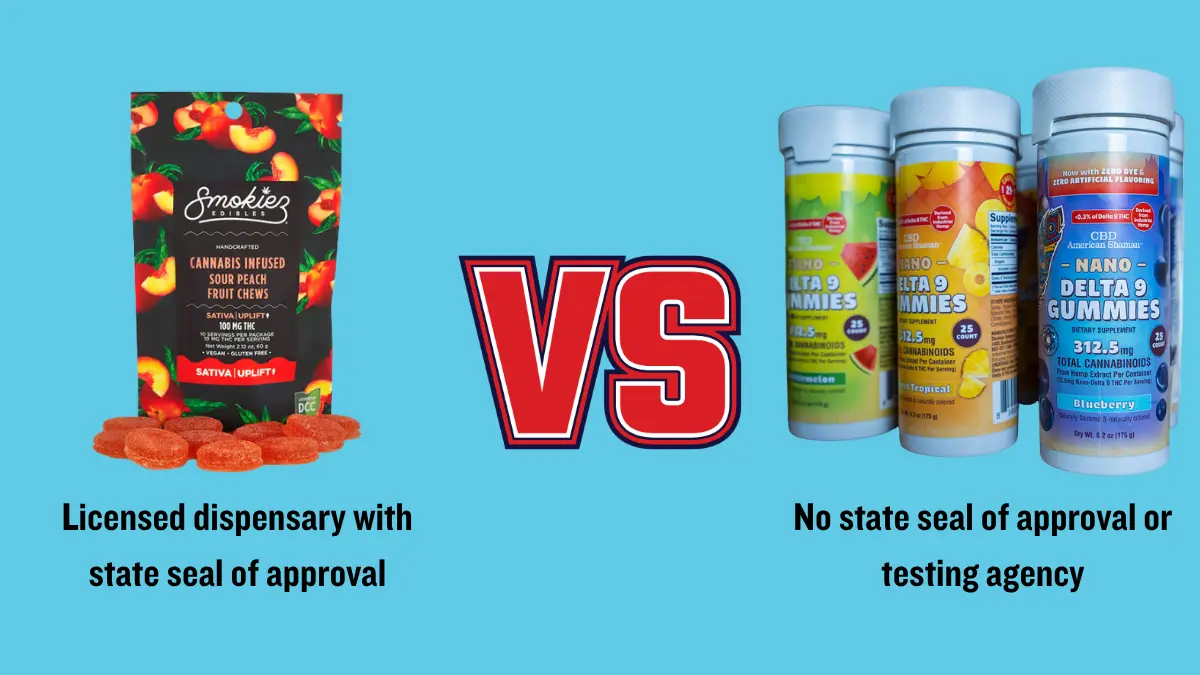
If delta-9 from a regulated dispensary is available to you legally, that's a different product category entirely — tested, labeled, age-gated, and sold by staff trained to help you choose. Most of the safety concerns around delta-8 are about the unregulated retail environment, not about THC itself.
Why Bloom sells regulated delta-9 THC instead
We're a licensed dispensary operator, and we've built our business around regulated cannabis for a pretty simple reason: it's a better product category for the customer.
Here's what regulation actually gets you, and why we think it matters:
Lab testing. Every product sold through a licensed cannabis program has to pass testing for potency, pesticides, heavy metals, residual solvents, and microbial contamination. You know what's in the product because a third-party lab verified it.
Accurate labeling. The milligram count on the package is the milligram count in the product. Full panel results are available on request or on the packaging.
Age-gated sales. You can't walk into a licensed dispensary as a minor. Staff verify ID every time.
Trained staff. Our budtenders can actually help you figure out what you're picking up — format, potency, expected onset, how it might interact with what you already use. That's the job, and it's the job precisely because cannabis rewards a little guidance.
Chain of custody. From licensed cultivator to licensed processor to licensed retailer, every step is tracked. Product recalls, when they happen, can actually reach the product.
Delta-8 exists because of a legal workaround, not because cannabis consumers or the cannabis industry decided it was a better product than regulated delta-9. We're not saying everyone who's tried delta-8 was wrong to try it — plenty of people in states without legal cannabis have reached for it as the only thing available. We're saying: if you have access to a licensed dispensary, that's what a dispensary is for.
If you're in Ohio, you can find us across the state at locations listed on our Ohio hub, or read through what to expect on a first dispensary visit if you're new. If you're in Maryland, come see us at our Germantown dispensary.
Frequently asked questions
Does delta-8 get you high?
Yes. Delta-8 is a psychoactive form of THC. The high is typically milder than delta-9, but it's a real high with real intoxicating effects. Don't drive or operate machinery after consuming it.
Is delta-8 THC the same as THC?
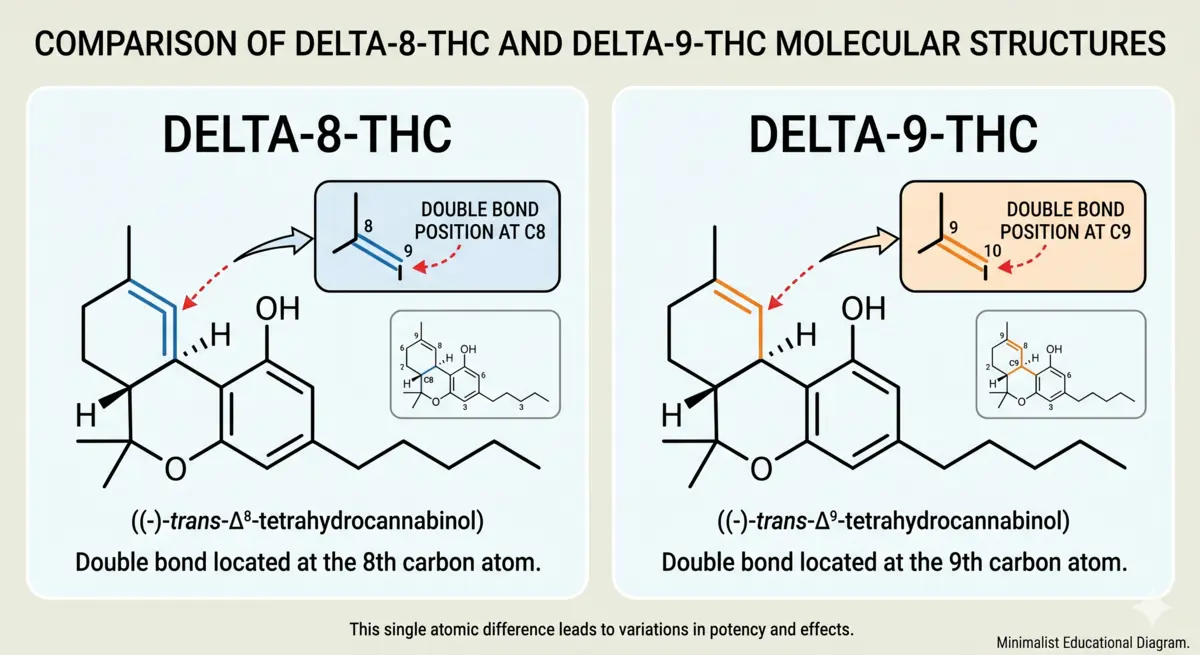
Delta-8 is a form of THC — it's tetrahydrocannabinol, just a different isomer than delta-9. When most people say "THC" in casual conversation, they mean delta-9 specifically, but both are THC.
Will delta-8 show up on a drug test?
Almost certainly, yes. Standard drug tests detect THC metabolites without distinguishing between delta-8 and delta-9. If you're subject to drug testing, avoid delta-8.
Is delta-8 natural or synthetic?
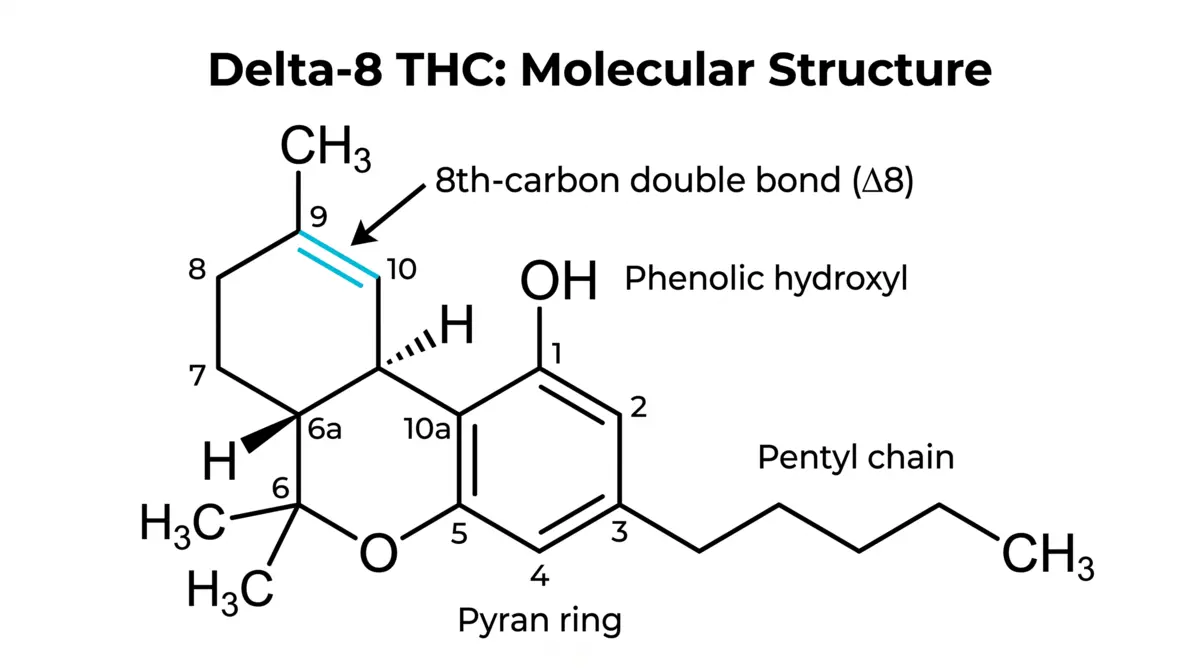
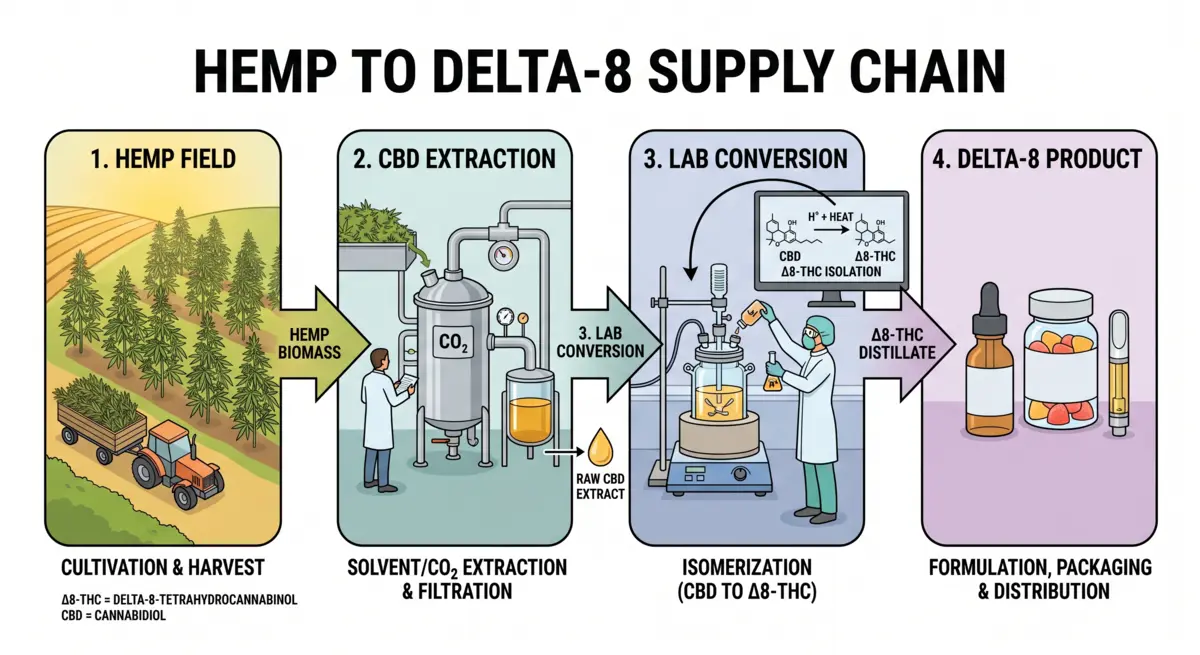
Semi-synthetic. Delta-8 exists naturally in the cannabis plant in trace amounts, but virtually all commercial delta-8 is produced by chemically converting hemp-derived CBD in a lab. The starting material is natural; the finished product is the result of a human-directed chemical reaction.
Is delta-8 safer than delta-9?
Not in a clear-cut way. The molecule itself isn't dramatically more dangerous at comparable doses, but most commercial delta-8 products are made and sold outside the regulatory framework that applies to licensed cannabis. So the practical safety question is less about the molecule and more about the product and the retailer.
How much delta-8 should I take?
General guidance: start low, go slow, wait for onset before re-dosing — the same principles that apply to any THC product. But dosing specifics for delta-8 are complicated by inconsistent labeling on unregulated products. Our edibles dosage guide covers dosing principles for regulated delta-9 edibles, which is a more predictable starting point.
Can I travel with delta-8?
Legally complicated and varies by jurisdiction. Federal airport security and state laws at your destination matter. Given the changes to federal hemp law effective November 2026, this question is likely to become more complicated, not less. Not recommended.